Saturday, July 16, 2011

Lord, why did you do this to me?

Homily, 16th Sunday Ordinary Time A
Fr. Paul D. Williams, Jr., Saint Joseph's, Dalton Georgia

St. Teresa of Avila was the greatest mystic in the history of the Church, and the first woman to be declared a Doctor of the Church, meaning that the Church considers her writings among the finest examples of true Christian doctrine and her life to be a model for us all. Well, the story goes that she was riding in her carriage one day, going from one convent to another, when suddenly she was thrown off, slammed rudely to the ground, and deposited in the middle of a mud puddle. She looked up to the heavens and said, “Lord, why did you do this to me?” And God answered her, “This is how I treat all my friends.” And St. Teresa replied tartly, “Then, Lord, it is not surprising that you have so few.” (Kreeft, Making... p.15)

All of us, it seems, even Saints, wonder why God allows evil and suffering. In today’s Gospel, Jesus speaks of the reality of the existence of evil and sin and suffering in the world, that the weeds will coexist with the wheat until the harvest at the end of time. Indeed, just looking at all the evil and suffering in the world is evidence of the truth of what Jesus said. Innocent people die at the hands of murderers everyday, be it in war or on the streets. Good, faithful people, even children, get diseases and suffer and die. Hurricanes, droughts, earthquakes kill thousands of people, seemingly indiscriminately. But it’s not just the suffering out there, it’s the everyday suffering which especially bothers us, as the Gospel says, all too often even households and families are divided against each other.

Sometimes, it seems, God doesn’t play fair, and even those who pledge their love for him suffer. Indeed the Psalms lament, “Why do the wicked prosper and the just suffer?” Tough delimna we have here. If God exists, as we believe; and if he is all-good, as we believe; and if he is all powerful, as we believe. Then, how can evil and suffering exist? Either he doesn’t exist, he isn’t all good, or he isn’t all powerful. After all, if he was truly God, he could have simply never allowed the enemy to plant the weeds and we could live in a perfect world. Yet we, as Christians say that he is all of those things.

So, how do we understand this problem? First, we need to understand what evil is. There are basically two types of evil: physical evil, and moral evil. Physical evil results from a disharmony in the world of nature. Moral evil results from disharmony in the human soul, sin.

But it is important to realize what evil is not. It is not a thing. It does exist, but it is not a positive reality that exists on its own. There seems to be a common belief today that good and evil are co-eternal, that one cannot exist without the other. As if there will always be good and always be evil, and we are destined for an eternal struggle, as if the Devil is the opposite of God. But that is not the Christian belief. Instead, evil is best understood as the lack of a good that ought to be. In other words, evil is a privation, a lack, a loss of some good that was supposed to be there. In this way, evil always refers to a good, like the weeds in the Gospel that can only grow up in the middle of the wheat, but not apart from it, preying on the good, as it were.

But, why does evil exist? Couldn’t God have created the perfect world where there was no evil, no suffering? Yes, he could have. But he didn’t. Why? For two reasons: first, physical evils exist because he chose to create a world which, as the new catechism says, is in a “state of journeying to its ultimate perfection” (CCC 310), so that there will always be physical evils - privation, lack - as long as creation has not reached that fulfillment. And the second reason is this: moral evils exist because God respects the freedom of his creatures – true freedom means to choose among the many goods that God has given us, but it also contains within it the ability to misuse that freedom and choose evil. Moreover, this freedom gives us the ability to truly love, because love involves the denial of ones own desires for the sake of another. Only a free person can do that. (CCC 311) So, God does not cause these evils, but they are a permitted consequence of true freedom.

And there’s the problem, why does God permit evil? Couldn’t he redirect the hurricane, protect the innocent, and cure the sick? Well, the answer lies in the Gospel parable today where the wheat is taken from the harvest at the end of time and the weeds are thrown away and burned. For God in his power and goodness, can draw good out from evil, by allowing the wheat to coexist with the weeds, he allows the wheat to reach maturity, to reach its fullness.

St. Thomas Aquinas explains it this way (CCC 412), “God permits evil in order to draw forth some greater good.” And Saint Augustine said, “For almighty God, because he is supremely good, would never allow any evil whatsoever to exist in his works if he were not so all-powerful and good as to cause good to emerge from evil itself.” In other words, evil doesn’t have to exist, but God permits it because he can draw good from it.

So, the ultimate answer to the problem of evil is not a thing, but a person, the person Jesus Christ. For from the greatest moral evil ever committed – the rejection and murder of God’s only Son, caused by the sins of all people – God brought the greatest of goods: the glorification of Christ and our own redemption. By taking on our humanity and embracing our suffering and confronting our evil, Jesus gives us two things: meaning to our suffering, and consolation through our suffering. Though he healed the sick and expelled demons, he never promised to free us completely from evil or suffering, but he did promise to show us its meaning, and to help us through it. Because of this, no one can ever look at God and say, “You don’t understand my pain, my hardship, the crosses I have to carry.” Because he does understand it, for he bore the greatest cross in the world, the Cross of Calvary, out of love for us and to save us.

By facing evil and enduring suffering with perseverance, patience, and charity, as Jesus did, we identify ourselves with our him, and his sufferings become ours, and ours become his. And what does this accomplish? Our own salvation and the redemption of the whole world.

You know, of all the answers out there to the problem of evil and suffering, Christianity is the only one that confronts it head on. Some would try to get rid of suffering by denying the existence of God and therefore removing all meaning from our lives. Others would try to deny suffering by eliminating people who suffer. But Christianity looks at the reality of suffering and finds its meaning in light of God’s love and the Cross.

And this Gospel parable which shows us of God’s infinite patience with the world, allowing the weeds and the wheat to coexist so that he might draw good from it, also tells us how we ought to view the world around us. In the world of souls, the bad seed, the weeds, can become good wheat, through repentance and conversion and God’s grace. Through patient and consistent love, we prepare ourselves and those around us for that true kingdom of perfection, the Kingdom of Heaven.

Saturday, July 9, 2011

Prejudicing the Soil Towards Roses and Strawberries

Homily, 15th Sunday OT A
Fr. Paul D. Williams, Jr., St. Joseph's, Dalton, Georgia

Today I am happy to welcome my little sister, Andrea, and her family. You may remember when I talked about my sister in last year's Amazing Race. If you like, after Mass, she will be happy to sign autographs. But the reason she is here tonight is that my niece, Allesandra, is here to celebrate her First Communion with her Uncle Father Paul. I have always been amazed at my sister and her children's love of their faith. How she manages to pass on her faith so effectively to her children, indeed all ten of them, is something that continues to impress me.

There are two important things that parent's need to know when trying to raise their children in the Catholic faith: First, faith is a gift; God goes about sowing the seed - the message about His reign - everywhere, even on the footpath and the rocky ground and the thorns. But secondly, this gift needs to be cultivated. St. John Chrysostom said it this way, “How is it [possible] to sow seed among thorns, or rocky ground or the footpath? For it is impossible that rock should become soil, or that the footpath should not be the footpath, or that thorns should not be thorns. But with [souls] it is otherwise; there it is possible that the rock be made rich soil, that the footpath should be no more trodden upon, and that the thorns should be extirpated.”

When we look at it from the perspective of a parent cultivating this gift of faith in a child, it can get kind of discouraging, especially in today’s world. I know many parents who try their best to raise and educate their children in the faith, yet sometimes are saddened when there appears to be no effect.

So if we are to cultivate the gift of faith in our children, we must seek to make them rich soil. We do this by removing the rocks, pulling the weeds, and not letting them grow up amidst the thorns. The rocks are the bad example we give them as they grow, and includes ways in which we do not live the Gospel, which make us out to be hypocrites in their eyes, or by not raising them well in the faith – simply sending them to CCD but not following up at home or by only requiring that they do the bare minimum to be Catholics, as is witnessed by the number of kids who drop out of religious education after confirmation. The weeds are the various influences of our culture which teach our children to be materialistic, hedonistic and selfish. We must guard our children against these things, especially those we find on television or popular culture. And, finally, the thorns are other people in our culture who have long since abandoned any Christian faith or values who harm our children by leading them astray into non-Christian ideas and practices. We must protect our children from them and give them the strength of faith so that they can one day defend themselves.

Samuel Taylor Coleridge has an interesting anecdote that may illustrate the dangers of not cultivating faith. He told this story: “I showed a friend my garden and told him it was my botanical garden. ‘How so?’ said he, ‘it is covered with weeds.’ - ‘Oh,’ I replied, ‘that is only because it has not yet come to its age of discretion and choice. The weeds, you see, have taken liberty to grow, and I thought it unfair of me to prejudice the soil towards roses and strawberries.’” In other words, it is the responsibility of parents to sow good virtues in their children, and not fall into this false belief that they can “decide on their own what to believe.” As Chesterton pointed out, the danger is not that they will believe in nothing, but that they may end up believing in anything.

But I think the parable of Jesus, and this anecdote from Coleridge, applies not only to how we should raise our children, but also to how we should cultivate our own faith.

My sister and I visited Bosnia several times in the 1980's, and I was always amazed to see the lay of the land. The mountains there are very rocky, and throughout the countryside, you can see stone walls, some thousands of years old. These are from the farmers who had to first clear the land of rocks before sowing their seeds. I spoke to some of the families who said that it took sometimes years or even decades to clear enough land to support just one family, and they did this through backbreaking labor – there weren’t many back-hoes or tractors around. In some places, the only way they could clear the land was with dynamite.

Well, we have to do the same for our souls. Like the farmer who cultivates his crop by removing rocks, pulling weeds, and getting rid of the thorn bushes, we must make our souls rich soil so that the seed of faith may grow to bear fruit. The rocks we must remove are the mortal sins which keep us from God: the capital sins of pride, avarice, envy, wrath, lust, gluttony, and sloth. (CCC 1866). The thorns are the venial sins which choke us off from further growth. And the weeds are those occasions of sin or idle thoughts, which quickly grow into thorns or even rocks if we do not remove them quickly. Like the farmer, this may take years of backbreaking work just to clear the field, and continuous work to keep it free of weeds and thorns, but that’s what the Christian faith requires. Practically, we do this through daily prayer, attendance at Mass, regular confession, active works of charity, and seeking reconciliation among ourselves and our community.

If we can do this, cultivating the gift of faith in our own lives and in that of our children, by cooperating with God’s grace, then we can be confident that the Lord will bring us to harvest in the eternal kingdom, as Isaiah said, “Just as from the heavens the rain and the snow come down and do not return there till they have watered the earth, making it fertile and fruitful… so shall my word be that goes forth from my mouth; it shall not return to me void, but shall do my will, achieving the end for which I sent it.” And that end, that goal, is our salvation.

Sunday, July 3, 2011

El Yugo Pesado Sobre Inmigrantes

Homilia 14 OT A - Inmigración
Padre Paul Williams (gracias a Padre Francisco Fernández-Carvajal)

Quiero pedir perdón a todos aquellos de origen hispano. El Estado de Georgia, donde nació y crecía, se ha aprobado y aplicado ahora una nueva ley contra los inmigrantes. La nueva ley es lamentable y una violación de la dignidad humana básica.

Nuestra parroquia ha participado en muchos aspectos, tratando de llamar la atención sobre este problema. Hemos hablado con el alcalde de Dalton, el jefe de la policía, los miembros del gobierno del condado. Hemos tenido reuniones para el diálogo entre los grupos defensores de latinos y líderes comunitarios. Hemos escrito cartas al gobernador, legisladores estatales y líderes nacionales. Nuestros feligreses han hablado con los periodistas y televisión.

Nuestros obispos, el señor arzobispo Gregory y señor obispo Zarama, también han intervenido en nombre de los inmigrantes. Han dicho en una declaración pastoral:
“Las Sagradas Escrituras nos enseñan que todos los seres humanos son creados a imagen y semejanza de Dios, que somos redimidos por Jesucristo, y que estamos llamados a compartir las cargas de los demás. Las Escrituras exigen una atención especial a los extranjeros, forasteros y otras personas vulnerables.

“...La dignidad humana y los derechos humanos de los inmigrantes indocumentados deben respetarse en todo momento, sea en el trabajo, en el hogar, en la escuela o en su participación en la vida comunitaria.

“...Como sus pastores, nos parece inaceptable que los niños sean separados de sus padres y sus familias, o que comiencen cada mañana preguntándose si este es el último día que verán a su madre, a su padre o a sus hermanos.

“... muchas personas indocumentadas continúan viviendo en las sombras, sin la seguridad básica u otros derechos humanos. A pesar de que a muchos se les retienen de sus salarios los impuestos federales y estatales, y de que todos pagan impuestos sobre ventas y otros gravámenes, saben que ser víctimas de un crimen o de un accidente de tránsito puede resultar en su arresto y deportación.

“Para la mayoría de estas personas, no hay una “línea” en la que esperar o “papeles” que firmar, porque nuestro sistema de inmigración roto no permite la posibilidad de su entrada legal a los Estados Unidos...

“Las personas de buena voluntad pueden no estar de acuerdo sobre la manera en que se puede lograr la reforma, pero no podemos alcanzar una reforma duradera, hasta que la disertación pública se concentre en soluciones, no en ataques personales sobre quienes ofrecen un apoyo fundamental a nuestra sociedad.

Ellos concluyen, “Al continuar nuestro llamado a los delegados en el Congreso para que apoyen una reforma abarcadora de inmigración, exhortamos a nuestros representantes estatales de Georgia a resistir la imposición de medidas legislativas severas e innecesarias que afecten a todos los residentes de Georgia, lo que rasgará aún más el tejido de nuestras comunidades, y pondrá en peligro nuestro futuro.”

El Señor nos dice en el Evangelio, “vengan a mí, todos los que están fatigados y agobiados por la carga, y yo les daré alivio.” Solo nuestro Señor puede darnos la paz y la tranquilidad de corazón que buscamos. En verdad, nuestro Señor no le quita todas nuestras cargas. Él llevó nuestros dolores y nuestras cargas más pesadas. Y nos manda que tenemos que tomar nuestro yugo sobre nosotros. De él nos aprendemos de que nuestro yugo es realmente suave y nuestra carga ligera.

El Evangelio es una continua muestra de la preocupación por todos de Jesucristo: «en todas partes ha dejado ejemplos de su misericordia», escribe San Gregorio Magno. Resucita a los muertos, cura a los ciegos, a los leprosos, a los sordomudos, libera a los endemoniados... Alguna vez ni siquiera espera a que le traigan al enfermo, sino que dice: Yo iré y le curaré. Aun en el momento de la muerte se preocupa por los que le rodean. Y allí se entrega con amor, como víctima de propiciación por nuestros pecados; y no solo por los nuestros, sino también por los de todo el mundo.

Para ser fieles discípulos del Señor hemos de pedir incesantemente que nos dé un corazón semejante al suyo, capaz de compadecerse de tantos males como arrastra la humanidad. La compasión fue el gesto habitual de Jesús a la vista de las miserias y limitaciones de los hombres: “Siento compasión de la muchedumbre...”, recogen los Evangelistas. Cristo se conmueve ante toda suerte de desgracias que encontró a su paso por la tierra, y esa actitud misericordiosa es su postura permanente frente a las miserias humanas acumuladas a lo largo de los siglos. Si nosotros nos llamamos discípulos de Cristo debemos llevar en nuestro corazón los mismos sentimientos misericordiosos del Maestro.

Nosotros debemos imitar al Señor: ayudando a a los demás a sobrellevar las cargas que tienen. Siempre que nos sea posible, asistiremos a otros en sus sufrimientos, en sus miedos, y en sus debilidades, en las cargas que la misma vida impone: El Santo Escrivá nos dice, «Cuando hayas terminado tu trabajo, haz el de tu hermano, ayudándole, por Cristo —¡Esto sí que es fina virtud de hijo de Dios!».

Liberar a los demás de lo que les pesa, como haría Cristo en nuestro lugar. A veces consistirá en prestar un pequeño servicio, en dar una palabra de ánimo y de aliento, en ayudar a que esa persona mire al Maestro y adquiera un sentido más positivo de su situación, en la que quizá se encuentre agobiada por hallarse sola.

No estamos solos. Somos el Cuerpo de Cristo, la iglesia una, santa, católica, y apostólica. El Señor nos dice, “No tengan miedo. Ustedes creen en Dios crean también en mí.” Podemos rezar la Misericordia Divina, “Jesús, en ti confío.”

The Heavy Yoke Placed on Immigrants

Homily 14th Sunday Ordinary Time, Cycle A
Fr. Paul D. Williams, Jr., pastor, St. Joseph’s, Dalton, Georgia

When Jesus refers to the “wise and the learned” in today’s Gospel, he was referring to the Pharisees, Scribes, and the leaders of the people of whom he said “They bind heavy burdens, hard to bear, and lay them on men's shoulders” (Mt. 23:4). For them, religion is a list of rules and regulations for how others ought to behave, and in their righteousness and arbiters of the law, they particularly liked to pile up these burdens on the weak, the defenseless, and the voiceless, almost making it impossible to live the Law and the Prophets as God truly intended.

Some Rabbis saw this and had a parable to illustrate the point. “There was a poor widow in my neighborhood who had two daughters and a field. When she began to plough, Moses (i.e. the Law of Moses) said, ‘You must not plough with an ox and an ass together.’ When she began to sow, he said, ‘You must not sow your field with mingled seed.’ When she began to reap and to make stacks of corn, he said, ‘When you reap your harvest in your field, and have forgotten a sheaf in the field, you shall not go back to get it’ (Deut. 24:19), and ‘you shall not reap your field to its very border’ (Lev. 19:9). She began to thresh, and he said, ‘Give me the heave-offering, and the first and second tithe.’ She accepted the ordinance and gave them all to Him. What did the poor woman then do? She sold her field, and bought two sheep, to clothe herself from their fleece, and to have profit from their young. When they bore their young, Aaron (i.e. the demands of the priesthood) came and said, ‘Give me the first-born.’ So she accepted the decision, and gave them to him. When the shearing time came, and she sheared them - Aaron came and said, ‘Give me the first of the fleece of the sheep’ (Deut.18:4). Then she thought: ‘I cannot stand up against this man. I will slaughter the sheep and eat them.’ Then Aaron came and said, ‘Give me the shoulder and the two cheeks and the stomach’ (Deut.18:3). Then she said, ‘Even when I have killed them I am not safe from you. Behold they shall be devoted.’ Then Aaron said, ‘In that case they belong entirely to me’ (Num.18:14). He took them and went away and left her weeping with her two daughters." (Barclay, Matthew, Volume 2, p. 16) The point of this parable was to illustrate how ridiculously burdensome and unjust the law becomes when interpreted by men who forget the dignity of each human person.

That's why when Jesus makes his famous, beautiful, and comforting statement, “Come to me, all you who labor and are burden, and I will give you rest”, he was speaking to the “little ones”, the poor, the widow, the orphan, the stranger, the “least of his brothers”. Those who labor, who are exhausted, come to Jesus and find rest. Those exhausted on the search for God, those exhausted looking for what is Right and what is Wrong, those exhausted with their daily duties and obligations, those exhausted with the burdens others have placed on them, those exhausted in their own struggle with sin, these come to Jesus and learn from his meekness and humility of heart. They find rest from a world that is confused about sin, capricious in its judgments, unkind and unjust to the weak, and many times simply cruel.

They find rest for their souls if not for their bodies in the person of Jesus. He came not to lift the burdens from us, but to carry them with us. He took upon himself the sorrows of the world because he shares in our sorrows and weeps when we weep. That’s why we have such great devotion to the Sacred Heart of Jesus, the feast day we celebrated this past Friday. His Divine Person has a human heart that loves, feels, and sorrows as we do.

Wherever he goes, the Evangelists tell us, “his heart is moved with pity for the crowds.” He cures the sick, gives sight to the blind, touches the leper, casts out demons, and raises the dead because of a widowed mother’s tears. Even on the cross, he shows mercy to the repentant thief.

This consolation, however, comes with a price. He says “Take my yoke upon you...” His yoke is his commandments, to love one another as he has love us. To lay down one’s life for one’s friends. This is an obligation imposed on us, the only burden Christ lays on us. But he says that his yoke is easy, his burden is light. A closer translation of “easy” is “well-fitting” (Barclay). Like the ox who has a custom-made yoke that fits well, tailored specifically to each ox so that it will not chafe or bruise, so also the Yoke of Christ. We each have our duties, our obligations, our burdens that we have no choice to carry. But we can choose to carry them with Christ, and they take on a new character, they become a joy, for a burden carried with love is no burden at all.

And it does not end there. Not only are we to take up our own Cross and follow after Him, we are to lighten the burdens of others. If we are to imitate Christ, we must view the world with his eyes. Have compassion on the crowds - the “little ones”, the poor, the widow, the orphan, the stranger, the “least of his brothers”. The religion of Jesus is not one which imposes impossible burdens on others, but seeks to make the ones people do carry light and easy, and not to add burdens which are unjust, capricious, and as Archbishop Gregory has said, “mean-spirited”.

I am speaking of course, of Georgia’s new immigration law, which ironically goes into effect the weekend we celebrate our freedom. Those who came here believing in that freedom are now being told that they are to have no part of it. Political cowards in their statehouses, the wise and the learned, have penned laws that label human beings created in God’s image and likeness as “illegal” and “criminals”. Are they? By man’s law, perhaps. By God’s law? Look at the results: families are divided, children who know no other home than Dalton are being sent to what is for them, a foreign country, people guilty of no serious crime are detained and deported, often separated from their families for months or more. In the name of political expediency, young people who call Dalton home and speak English with a Southern Drawl are told they are undesirable: they cannot legally get a driver’s license and will be detained and deported for not having one; they do well in our local schools but are told they cannot receive a higher education; they want to work and make a life for themselves in this land of the free, but are told they cannot work legally. Good people, as much as 30% of your brothers and sisters here at Saint Joseph’s, are living in fear, and many have already left.

Christ is there on the Cross, carrying the burden of our sins, and we have refused him. As St. Augustine would have Jesus tell Peter on the Mount of the Transfiguration, when Peter thought he was in heaven and wanted to stay, “Come down, Peter: you desired to rest on the mountain; come down, preach the word, be persistent in season, out of season, reprove, rebuke, exhort with all long-suffering and teaching. (2 Tim 4:2) ... The glory [you see] has been reserved for you, Peter, but for after death. For now, Jesus says to you, ‘Go down to toil on earth; to serve on earth, to be scorned and crucified on earth. [I am the] Life who goes down to be killed; [I am the] Bread who goes down to suffer hunger; [I am] the Way goes down to be exhausted on his journey; [I am the] Fountain who goes down to suffer thirst; and you refuse to suffer? Seek not your own. Have charity, preach the truth; then you shall come to eternity, where you will find your rest.’” (CCC 556)

I for one, have no intention of resting while our brothers and sisters in Christ are suffering and carrying this heavy burden.

Saturday, July 2, 2011

Father Juan's First Mass on Trinity Sunday

Father Juan Jose's First Mass at Saint Joseph's, Trinity Sunday 2011

We were privileged yesterday to attend Juan José Teran's ordination to the preisthood yesterday at the Cathedral. He is a member of our parish and is now serving in the Archdiocese of Atlanta. Join me in expressing our warm congratualtions to Juan and his family who are present today.


And now Juan, you are a priest. Who would have thought it? Well, let me tell you this: God thought it, for he not only called you to the priesthood, he gave you the grace to respond to his call. And I am sure that I echo the thoughts of all here today when I tell you what great joy it gives me now to address you as “Father.”

Well, Father, what I’d like to do is this: I’d like to propose for you a few models for your priestly ministry.

1. The first model, I propose, is our patron, St. Joseph. Cultivate a strong devotion to St. Joseph, because I believe he will help you in many ways. It is no coincidence that Catholics call their priests “Father”, for a priest must have the qualities of a family man. St. Joseph’s example of hard work, humble service, and self-sacrificing dedication to others will help you to be a “Father” to the people in your parish. So, model your ministry on St. Joseph, the family man.

But, St. Joseph also helps you in another way, for like you, he was called to and accepted the gift of celibacy. Now, as you and I both know, celibacy is something that is often misunderstood or looked down upon in our culture today. I’m reminded of what St. Paul said towards the end of his ministry: (2 Tim. 4:6), “For I am already being poured out like a libation.” In the ancient world, a libation was something precious, like fine wine or sacred oil, which was poured out on the ground in sacrifice as an offering to God. In the eyes of men, it appeared to be wasted, but in the eyes of God, it was a precious act of sacrifice which showed trust and dependence on Him.

And now, Father, you are that libation. In the eyes of the world, the call to celibacy you have accepted will appear to be a waste. But in God’s eyes it will be a precious gift. You will pour out your life in service of others, sacrificing your own desires for a family, so that you can be a father, brother, and son to all of God’s people - part of a much larger, spiritual but very real family - the Church.

But you know what else St. Paul would say? (Philip. 2:17-18), “But, even if I am poured out as a libation upon the sacrificial service of your faith, I rejoice and share my joy with all of you. In the same way you also should rejoice and share your joy with me.”

So, Father, rejoice in your call, share your joy with God’s people. And for all of you, rejoice as well in Father Juan’s call and give thanks to God that he responded.

2. Now, the next model for your priesthood that I would like to propose is Moses (first Reading). Now, Father Juan, I’m not talking about the Charleton Heston version of Moses in the movie - where he comes down from the mountain, with the glory of God showing on his face, his gray hair and beard blowing in the wind with thunder and lightning all around, and the two tablets of the commandments in either hand. (So, I’m not telling you to grow a beard and add a touch of gray...)

No, I’m talking about the Moses we find in Scripture. When he went up to Mount Sinai to be with the Lord and was gone for forty days, the people lost faith, sinned, and fashioned the golden calf to worship. God was going to punish them so that they would never reach the promise land. But, you know what Moses did? He implored the Lord, pleaded with the Lord, and begged the Lord to have mercy on his people. As the Israelites would sing for a thousand years afterwards in the psalm (106), he “stood in the breach before him.” And God heard his prayer, had mercy, and they reached the promised land.

And Father, that is your job: to get on your knees every day and pray for God’s people, to stand in the breach between God and man. Pray that they come to know his mercy, that they set their sights on heaven. We live in a confused world, Father. The golden calves being worshiped are many, it seems that few people seek the promised land of heaven, and you must help them to find Jesus Christ. And we live a very broken world, Father. So many of God’s people carry burdens they are afraid to carry, weaknesses they fear cannot be overcome, sins they believe cannot be forgiven. And your job, Father, is to be a healer not a judge, a source of strength not of despair, the flame of God’s mercy not the instrument of his wrath.

And Father, you will do this especially in the confessional, where people will come to you with these burdens. And take that duty very seriously, Father. For God himself wants you to stand there in the person of his Son, offering his people hope, consolation, pardon, peace, and the forgiveness of their sins.

3. As the next model for your priesthood, Father, I offer you Saint Paul. Follow his example and preach the truth no matter what the cost.

That great preacher St. Paul would say three things about preaching, which I would like to give you. First he said, (1 Cor. 9:16) “If I preach the gospel, this is no reason for me to boast, for an obligation has been imposed on me, and woe to me if I do not preach it!” You have been given a very serious obligation by God himself to preach, and woe to you if you do not carry it out. Next, St. Paul would say, (1 Cor. 9:14) “In the same way, the Lord ordered that those who preach the gospel should live by the gospel.” So you have the duty of not only proclaiming the Gospel, but also of living it as an example to others. Archbishop Gregory said yesterday that this means you may be held to a higher standard - the people expect it of you, as well they should. And this Gospel that you preach, this Gospel that you live, what is it? Well, finally, St. Paul would say, (2 Cor. 4:5), “For we do not preach ourselves but Jesus Christ as Lord, and ourselves as your slaves for the sake of Jesus.” Your call to the priesthood, Father, is not about you, but about Jesus Christ. At my ordination, they sang “Non Nobis Nomine Domine”. That’s the first verse from Psalm 115, “Not to us, Lord, not to us, but to your name give the glory.” Your service, your priesthood, your very life is for His glory, so that people may come to know His name.

So, Father, like Stephen, preach Jesus Christ, preach the truth as handed down in his Church since the time of the apostles, preach it no matter what the cost, and preach it with mercy, like Stephen. His attackers would cover their ears so as not to hear what he was saying, but even as they stoned him, he prayed for them, “Father, do not hold this sin against them.” Preach the truth with mercy, Father. Preach what St. Paul would call “the inscrutable riches of Christ.” (Ephes. 3:8)

4. And so finally, Father, model your priesthood on him, the great high priest, Jesus Christ our Lord. And how appropriate it is that today’s Gospel is the high priestly prayer of Jesus from John 17. Look what he says, “I do not pray for my disciples alone. I pray also for those who believe in me through their word.” Who is he praying for? He’s praying for you and the people you minister to. What a great obligation you have been given - people will come to believe in him because of you - because of the witness of your life, the mercy you show, and the word that you preach. Model your prayer on Jesus’: “That they all may be one” - that the world may know the love and mercy of God - that our unity may be complete by living in him, and he living in us.

Now, Father, I have been telling you about all the great obligations you have accepted: celibacy, forgiving sins, preaching the Gospel, praying for God’s people. But, your greatest obligation is why we are gathered here today: the Eucharist. I’ve told you already that your call to the priesthood is not about you, but about Jesus Christ. As a priest, you stand before us “in persona Christi”, in the person of Christ. You are so identified with him through your ordination that when you act in the sacraments, Jesus Christ acts through you. And in a few minutes, when you lift up that host, you will dare to say, “This is my body”, and that simple host will become the Body of our Lord, so that we may be one with him and he may live in us. And when you lift up the cup and say, “This is the cup of my blood”, you will be lifting up the cup of salvation, and that precious chalice will be filled with the Blood of our Lord, the price paid for our redemption. How can you dare to say those words? Because it will be Jesus Christ saying those words through you, with you, and in you.

And so Father Juan, I’ve said enough. These people didn’t come here today to hear me preach, they came here to meet Jesus in the Eucharist, through you, our priest. So I’ll end with the words of St. John at the end of the book of Revelation, “Amen! I am coming soon. Maranatha! Come, Lord Jesus!”

Sunday, June 26, 2011

Lauda Sion! Corpus Christi 2011

Laud, O Zion, your salvation, Laud with hymns of exultation,
Christ, your king and shepherd true:
Bring him all the praise you know, He is more than you bestow,
Never can you reach his due.

Special theme for glad thanksgiving Is the quick'ning and the living
Bread today before you set:
From his hands of old partaken, As we know, by faith unshaken,
Where the Twelve at supper met.


Full and clear ring out your chanting, Joy nor sweetest grace be wanting,
From your heart let praises burst:
For today the feast is holden, When the institution olden
Of that supper was rehearsed.

Here the new law's new oblation, By the new king's revelation,
Ends the form of ancient rite:
Now the new the old effaces, Truth away the shadow chases,
Light dispels the gloom of night.


What he did at supper seated, Christ ordained to be repeated,
His memorial ne'er to cease:
And his rule for guidance taking, Bread and wine we hallow,
making Thus our sacrifice of peace.

This the truth each Christian learns, Bread into his flesh he turns,
To his precious blood the wine:
Sight has fail'd, nor thought conceives, But a dauntless faith believes,
Resting on a pow'r divine.

Here beneath these signs are hidden Priceless things to sense forbidden;
Sign, not things are all we see:
Blood is poured and flesh is broken, Yet in either wondrous token
Christ entire we know to be.

Whoso of this food partakes, Does not rend the Lord nor breaks;
Christ is whole to all that taste:
Thousands are, as one, receivers, One, as thousands of believers,
Eats of him who cannot waste.

Bad and good the feast are sharing, Of what divers dooms preparing,
Endless death, or endless life.
Life to these, to those damnation, See how like participation
Is with unlike issues rife.

When the sacrament is broken, Doubt not, but believe 'tis spoken,
That each sever'd outward token doth the very whole contain.
Naught the precious gift divides, Breaking but the sign betides
Jesus still the same abides, still unbroken does remain.

Lo! the angel's food is given To the pilgrim who has striven;
See the children's bread from heaven, which on dogs may not be spent.
Truth the ancient types fulfilling, Isaac bound, a victim willing,
Paschal lamb, its lifeblood spilling, manna to the fathers sent.

Very bread, good shepherd, tend us, Jesu, of your love befriend us,
You refresh us, you defend us, Your eternal goodness send us
In the land of life to see.

You who all things can and know, Who on earth such food bestow,
Grant us with your saints, though lowest,
Where the heav'nly feast you show,
Fellow heirs and guests to be.

Amen. Alleluia.

Sunday, June 12, 2011

The Fruits of the Holy Spirit

Homily Pentecost 2011
Fr. Paul D. Williams, Jr.
Special thanks to Padre Francisco Fernández-Carvajal

Jesus would speak of the Holy Spirit as a “wind which blows where it wills”. Therefore, the Saint is like a ship with its sails unfurled, attentive to the blowing of the gentle breeze and going where it leads.

When we are docile to these inspirations of the Holy Spirit, we become, to use another analogy from Jesus, that good tree which is known by its fruits. These fruits enrich our lives and are manifestations of the glory of God, as Jesus said at the Last Supper: “By this my Father is glorified, that you bear much fruit.”

These supernatural fruits are countless. St Paul offers us twelve fruits to meditate on, which have become the fruits listed in the Tradition of the Church, the result of the Seven Gifts which the Holy Spirit has infused in our soul through baptism. They are: love, joy, peace, patience, kindness, goodness, generosity, gentleness, faithfulness, modesty, self-control, chastity.

First is love or charity, the first sign of our union with Christ. This is the most excellent of these fruits, making us feel the loving presence of God, always close, and motivating us to ease the burdens others carry. This is the first sign of the action of the Holy Spirit in us: an active charity towards those around us. St John Chrysostom: “There is no sign or mark which distinguishes the Christian and the lover of Christ greater than the care of our brothers and sisters and zeal for the salvation of souls.”

This first and chief fruit of the Holy Spirit is, as St Thomas says, “followed necessarily by joy, since the lover rejoices in union with his beloved.” Joy is the result of love; therefore a faithful Christian is distinguished by joy, and this joy persists through sorrow and failure. Joy can bring great good to the world, as we sing in our hymns, “Joy to the World” as Christ comes into the world through his people. As one spiritual writer puts it, “To rejoice under trial, to smile in sufferings..., to sing in our heart ever more clearly, the longer and sharper the thorns.., and all this for the sake of love.., this is, together with love, the fruit that the divine Vinedresser wishes to gather from the branches of the mystic Vine. These are fruits which only the Holy Spirit can produce in us.”

Love and joy give us what St. Paul calls, “the peace of God which surpasses all understanding.” St Augustine defines it as tranquility in order. There is a false peace based on disorder, which comes about when we don't want to “rock the boat”, a “let's don't make it worse” attitude, which some see as the only option, but doesn't address the root of a disorder.

Peace, the fruit of the Holy Spirit, is the absence of unrest, where the mind and will are at repose, content in knowing and living the good. It requires a continual battle against our own disordered tendencies so that this peace is transparent to others.

Only in heaven shall we find the fulness of love, joy and peace. But we can experience a foretaste of it now if we are open to the Holy Spirit and faithful. We do enjoy these fruits now, and the taste of them is sweeter than anything this world offers, but it is only a foreshadowing of what awaits us. And this is where the fruit of patience comes in. Patience is serenity without complaint or protest in the face of the physical and moral sufferings which we experience in life.

Many people tell me, “Father, I am too impatient, how can I be more patient?” Well, Charity is full of patience and patience is frequently what supports love. So the simple answer is: love more. When duties are no longer an imposed obligation but a loving desire to work for the good of others, then patience naturally follows.

Related to patience is another fruit called longanimity, which is calmness in the face of suffering and adversity; when we are without complaint or bitterness for as long as God wishes, certaint that he is true to his promises and that the rewards will come sooner or later. No importance the length of the wait, more important is the certainty in the waiting. As St. Paul would say: “in hope, we wait with endurance.” That is patience and longanimity or forebearance.

Many fruits are directly related to love of neighbor. Goodness makes us desire the good of others without distinction, not just for those we love, but also for those who may make life difficult for us. Kindness is that desire in action. If you encounter a person who is irritable and cranky, maybe they are just having a terrible day, and you can make it better for them with a kind smile or word, compassionate and understanding. And if they’re just that way by nature, it has not harmed you to return kindness for crankiness. Desiring the good for others also frees us from jealousy or envy. To allow these fruits to flourish, start with the knowledge that all those you meet are children of God whom He loves and for whom Christ died on the Cross. Generosity naturally follows.

Gentleness is united to goodness, a characteristic of Charity, in that Charity is not irritable or resentful, prone to anger or harmful outbursts. A gentle person does not harbor resentments for perceived offenses or insults from others.

Faithfulness follows gentleness. A faithful person fulfills their duties, large and small, and enjoys the trust of others. A faithful person is dependable. As Sacred Scripture says: “A faithful friend is a sturdy shelter; he who finds one finds a treasure.” A faithful person lives goodness and justice and charity.

The last fruits refer to the virtue of temperance. A modest person behaves serenely and properly in each situation. A modest person appreciates the talents he or she has, but does not magnify or minimize them, recognizing all is a gift from God meant for the service of others. As a fruit of the Holy Spirit, it is manifest in ones speech and dress, and it is attractive because it manifests simplicity and inner order.

Finally, Self-Control and Chastity. These fruits give beauty to the Christian life and helps one to see God present in all things and lift one up from a carnal view of the world. After all, Jesus says, “Blessed are the pure of heart, for they shall see God.” These fruits give us strength in the face of worldly temptations, and God’s grace is always sufficient.

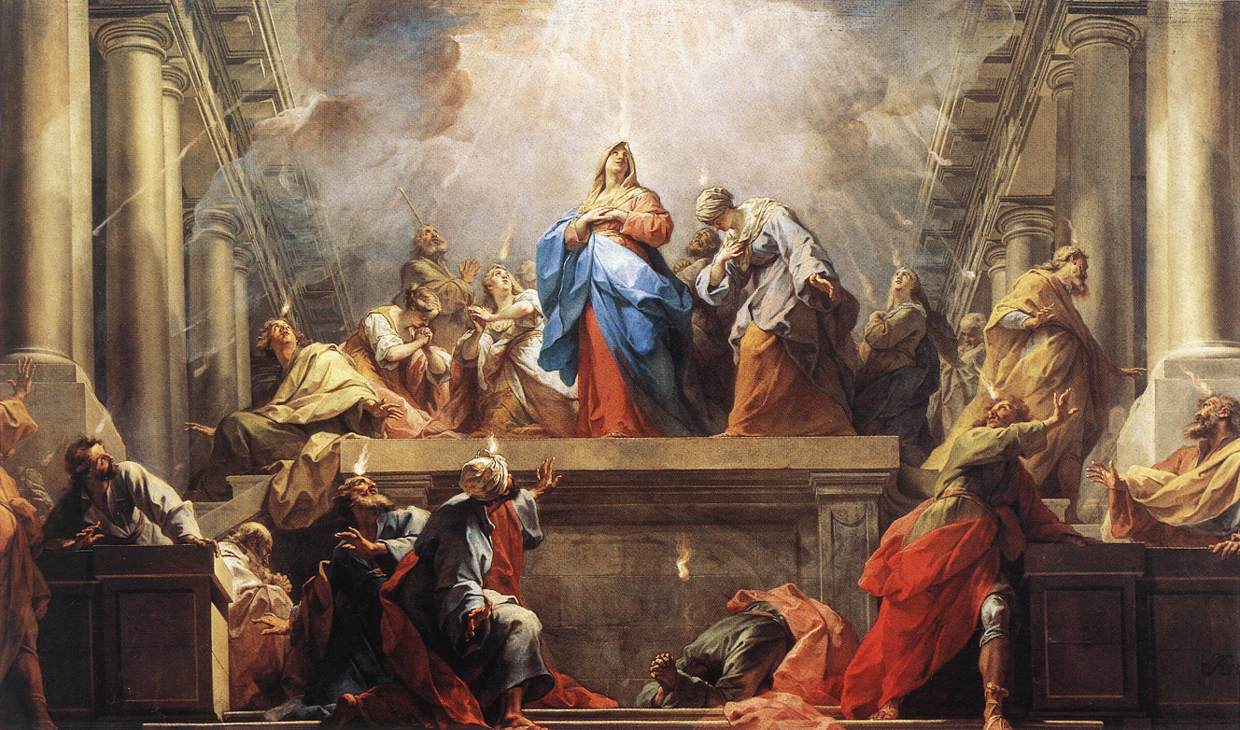
On this Pentecost Sunday we have the great privilege of gathering as the early Church did, with Mary, in prayer, praying for the outpouring of the gifts and fruits of the Holy Spirit in our lives, so that we might enjoy those fruits eternally in Heaven.